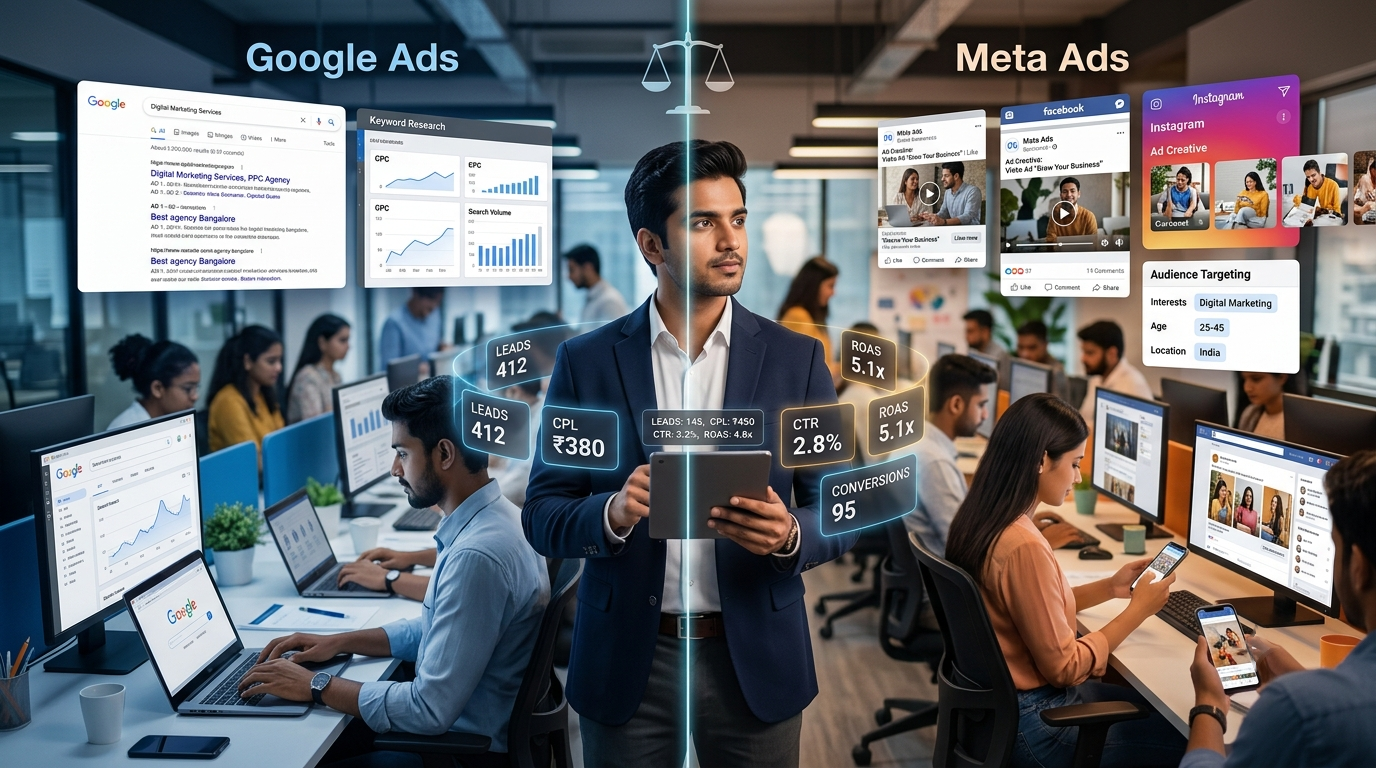
Google Ads vs Meta Ads for Leads: Which Platform Should You Actually Use?

Use Google Ads when people are already searching for what you sell — it captures existing demand at the moment of intent. Use Meta Ads (Facebook and Instagram) when you need to create demand and put your offer in front of people who aren’t looking for it yet. For most local service businesses, Google wins first; for visual, impulse, or new-category offers, Meta wins first.
If you only remember one line from this post, remember this: Google captures demand. Meta creates demand. Almost every other decision flows from that difference.
Let’s break down exactly which one fits your business.
The one difference that decides everything: intent
The mistake most business owners make is comparing Google and Meta on price (“which is cheaper?”). That’s the wrong question. The right question is: is your customer already looking for you, or do they not know they need you yet?
- On Google, someone types “emergency plumber near me” or “GST filing service in Hyderabad.” They have a problem right now and they’re hunting for a solution. Your ad meets them at the exact moment of intent. This is called demand capture.
- On Meta, nobody opens Instagram thinking “let me buy a course today.” They’re scrolling to relax. Your ad interrupts them with an offer they didn’t know they wanted. This is called demand generation.
Neither is better in the abstract. They’re better for different situations. Match the platform to how your customer buys, and the “which is cheaper” question mostly answers itself.
Google Ads vs Meta Ads for leads: side-by-side
| Factor | Google Ads | Meta Ads (Facebook / Instagram) |
|---|---|---|
| Core strength | Captures existing demand (search intent) | Creates new demand (interruption) |
| Buyer mindset | “I have a problem, find me a solution” | “I wasn’t looking, but that’s interesting” |
| Targeting basis | Keywords people search | Interests, behaviours, lookalike audiences |
| Best for | Service businesses, urgent needs, high-intent queries | Visual products, impulse buys, new/unknown offers |
| Creative needs | Text-first; low creative effort to start | Scroll-stopping video/image is non-negotiable |
| Lead cost pattern | Higher cost per click, but warmer leads | Lower cost per reach, but colder leads |
| Speed to first lead | Fast — demand is already there | Slower — you must earn attention first |
| Learning curve | Keyword and match-type discipline | Creative testing and audience iteration |
When you should choose Google Ads first
Choose Google Ads when there is active search volume for what you sell. If people literally type your service into Google — plumbers, lawyers, dentists, coaching, repair, “near me” local services, B2B software with a known category — you should almost always start on Google. You’re paying to appear in front of someone who already raised their hand.
Google Ads is the stronger first choice when:
- Your service solves an urgent or “need-it-now” problem. Emergency, repair, medical, legal, “same-day” — people search these, they don’t discover them while scrolling.
- You sell a known category. If customers can name the thing they want (“CRM software,” “tax consultant,” “IELTS coaching”), they’re searching for it.
- You have limited creative resources. A decent Google search ad is mostly good copy. You don’t need a video team on day one.
- You want warm leads fast. Search intent means shorter path from click to enquiry.
The trade-off: clicks cost more, and if there’s little search volume for your offer, Google simply won’t have an audience to show you.
When you should choose Meta Ads first
Choose Meta Ads when your offer is visual, impulse-driven, or too new for anyone to be searching for it. Meta’s superpower is showing a compelling offer to people who weren’t looking — using interest, behaviour, and lookalike targeting to find people who look like your best customers.
Meta Ads is the stronger first choice when:
- Your product is visual or lifestyle-driven. Fashion, food, fitness, décor, real estate, anything that sells on a scroll-stopping image or video.
- You’ve created something people don’t search for yet. A new product category, a novel service, an info-product — nobody Googles what they don’t know exists.
- You have strong creative. Good hooks and native-feeling video are the difference between winning and burning money on Meta.
- You want cheaper reach and volume at the top of the funnel. Meta typically delivers far more impressions per rupee than Google search — great for awareness and retargeting.
The trade-off: leads are colder, the sales cycle is longer, and your results live or die by creative. Weak creative = wasted budget, no exceptions.
What about budget? Where should a small business start?
If your monthly budget is small (say under ₹30,000–₹50,000 or a few hundred dollars), don’t split it across both platforms at once. A thin budget spread across two channels learns nothing on either. Pick the one platform that matches your buyer, give it enough spend to gather data, and only expand once it’s working.
A simple starting rule:
- Do people search for what you sell? → Start with Google.
- Do people need to discover what you sell? → Start with Meta.
- Not sure? → Start with Google if you’re a local service business; start with Meta if you’re a visual or new-category product.
Give any campaign at least 2–4 weeks and enough budget to generate a meaningful number of conversions before you judge it. Ad algorithms need data to optimize — killing a campaign after three days tells you nothing.
Should you run Google and Meta together?
Eventually, yes — the strongest lead engines use both, and they feed each other. But sequencing matters more than doing everything at once.
The classic combination once you have budget to spend:
- Google captures the people actively searching (bottom of funnel).
- Meta builds awareness and retargets everyone who visited your site but didn’t convert (top and middle of funnel).
A powerful, underused play: run Meta to introduce your brand, then use Google retargeting and brand-name search to close the people Meta warmed up. When someone sees your Meta ad, then Googles your business name later, you want to own that search result. Used together, the two platforms cover the whole journey — but only add the second platform once the first one is profitable.
What do leads actually cost on each?
Honest answer: it varies enormously by industry, location, competition, and your own creative and landing page — so treat any single number with suspicion. But the pattern is consistent and worth knowing:
- Google search usually has a higher cost per click because you’re bidding against competitors for high-intent keywords — but those clicks convert better, so the cost per qualified lead can be very reasonable.
- Meta usually has a lower cost to reach and click, because you’re interrupting cold audiences — but more of those leads are early-stage, so you often need more of them to get one sale.
The metric that actually matters isn’t cost per click or even cost per lead — it’s cost per customer (and the revenue that customer brings). A “cheap” Meta lead that never buys is more expensive than a “pricey” Google lead that closes. Always measure down to the sale, not the click.
Frequently asked questions
Is Google Ads or Meta Ads better for lead generation? Neither is universally better. Google Ads is better for capturing people already searching for your solution (ideal for service businesses and urgent needs). Meta Ads is better for creating demand for visual, impulse, or new offers. Match the platform to whether your customer is actively searching or needs to discover you.
Which is cheaper, Google Ads or Meta Ads? Meta usually has a lower cost per click and cheaper reach, while Google has higher click costs but warmer, higher-intent traffic. “Cheaper” depends on what you measure — Meta often looks cheaper per click but can cost more per actual customer if the leads are colder.
Can I run Google Ads and Meta Ads at the same time? Yes, and mature lead engines use both. But if your budget is small, start with just one — the platform that matches your buyer — then add the second (usually for retargeting) once the first is profitable.
Which platform should a local service business use? Almost always Google Ads first. Local service buyers actively search (“electrician near me”), so Google captures them at the exact moment of intent, delivering warmer leads faster than Meta.
How much budget do I need to start? Enough on a single platform to gather real data — usually a few weeks of consistent spend that produces a meaningful number of conversions. Splitting a small budget across both platforms is the most common way beginners waste money.
The bottom line
Stop asking “Google or Meta?” and start asking “Is my customer searching, or scrolling?”
- Searching for a solution → Google Ads.
- Scrolling and needs to discover you → Meta Ads.
- Small budget → pick one, prove it works, then expand.
Get the intent match right, and the platform choice — and your cost per lead — mostly takes care of itself.