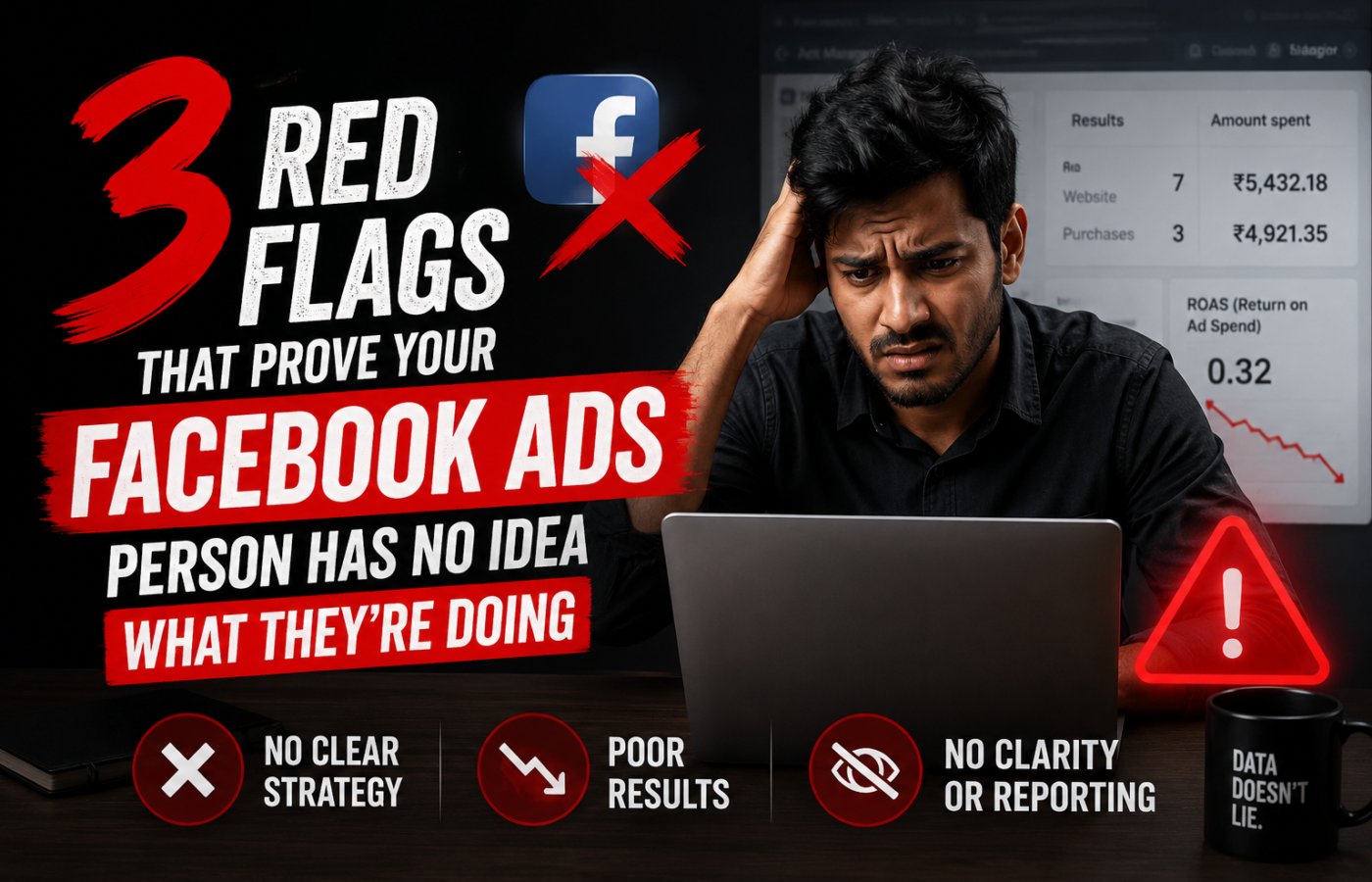
3 Red Flags That Prove Your Facebook Ads Person Has No Idea What They’re Doing

The three clearest signs your Facebook (Meta) ads person doesn’t know what they’re doing are: 1) they report reach and engagement instead of cost-per-lead or cost-per-sale, 2) the campaign structure hasn’t changed in months, and 3) they can’t explain why performance went up or down. Any one of these means the account is being watched, not managed.
I’ve spent the last four years doing something most agencies don’t: opening up other people’s ad accounts after things have already gone wrong.
Business owners come to me with the same story. “My ads guy sends me a screenshot every month, but I don’t actually know if it’s working.” So I go into Ads Manager, and within about ten minutes, I usually know exactly why.
Here’s the thing — you don’t need to understand campaign objectives, audience targeting, or the Meta algorithm to know if your ads person is any good. You just need to know what to look for. After auditing 200+ accounts across real estate, D2C, local services, and course businesses, the same three red flags show up again and again. If you spot even one of these, it’s worth a serious conversation.
Red Flag #1: They Report Reach and Engagement Instead of Cost-Per-Lead or Cost-Per-Sale
This is the big one. It’s also the easiest to miss, because the numbers look impressive.
“We reached 45,000 people this month.” “Engagement is up 30%.” “Your ad got 200 comments.”
None of that pays your bills.
I audited a real estate account in Bangalore where the monthly report was three slides of reach and impression charts, all pointing up and to the right. The client felt great about it — until I pulled the actual numbers and found the cost per lead had gone from ₹180 to ₹1,400 over five months. Nobody had flagged it. Nobody had even calculated it, as far as I could tell.
Reach and impressions in a monthly report is a confession, not a metric. It’s what people show you when they don’t have a good number to show you.
What to ask instead: “What’s my cost per lead this month, and how does that compare to last month?” If your ads person hesitates, deflects, or has to “go check,” that’s your answer.
Red Flag #2: The Campaign Structure Hasn’t Changed in Months
Meta ads are not a “set it and forget it” system. Audiences get tired. Creative fatigues. Costs creep up as the algorithm exhausts the best-performing segment of your audience and starts showing your ad to people who are less likely to convert.
A good ads person is constantly testing — new creative, new angles, new audiences, new offers. A bad one sets up a campaign once and lets it run untouched for months, coasting on whatever momentum it had in week one.
I saw this exact pattern with a D2C brand whose account had 14 overlapping audiences all competing against each other in the same ad auction — essentially bidding against themselves — because nobody had ever opened the Audience Overlap tool, let alone acted on it. The static creative running the account had been live, unchanged, for five months straight.
What to ask instead: “What have you tested or changed in the last 30 days, and why?” If the honest answer is “nothing,” the account is on autopilot — and autopilot doesn’t adapt when performance drops.
Red Flag #3: They Can’t Explain Why Something Is or Isn’t Working
This is the one that separates someone who’s actually managing your account from someone who’s just watching it.
Ask a competent ads person why cost-per-lead spiked last month, and you’ll get a specific answer: creative fatigue, audience saturation, a landing page issue, increased competition in the auction, a seasonal dip. It might not be the answer you want, but it’ll be an answer.
Ask a bad one, and you’ll get a shrug. Or worse — “the algorithm’s just like that sometimes.” I’ve watched clients accept that line for months at a time. If your ads person says “the algorithm needs more time” after three-plus weeks with zero results, that’s not strategy. That’s stalling.
A course creator I worked with was running what looked like a lead-generation campaign — but it was actually optimized for engagement. Great comment counts, plenty of “activity” to point to in the report. Almost zero actual leads. The person running it either didn’t know the difference or hoped the client wouldn’t ask.
What to ask instead: “Why did this happen, specifically?” Vague answers about “the algorithm” or “the market” without a specific, testable explanation mean nobody’s actually diagnosing the account — they’re just watching numbers move.
The Pattern Behind All Three
Every one of these red flags comes down to the same root problem: the person running your ads is reporting activity, not managing performance. Busy-looking dashboards, decent-looking screenshots, and vague reassurances are a lot easier to produce than actual results — and most business owners don’t have the time or Ads Manager fluency to tell the difference until the damage is already done.
Frequently Asked Questions
How do I know if my Facebook ads person is bad? Check three things: whether they report cost-per-lead or cost-per-sale (not just reach and engagement), whether the campaign structure has changed in the last 30 days, and whether they can give you a specific reason for any performance change. If all three come back weak, the account isn’t being actively managed.
What metrics should a Facebook ads manager report every month? At minimum: cost per lead (or cost per sale), spend versus budget, conversion rate, and a comparison to the previous month. Reach and impressions can be included as context, but they shouldn’t be the headline numbers.
How often should Facebook ad campaigns be updated or tested? Active accounts typically need creative or audience adjustments every 2–4 weeks, since ad fatigue and audience saturation build up over time. An account that hasn’t changed in months is usually running on autopilot.
Is it normal for Facebook ads to take time to work? Some learning-phase adjustment in the first 1–2 weeks is normal. Three or more weeks with no results and no specific explanation is not — that’s a sign the account needs a diagnosis, not more patience.
If you want to check your own account against these exact issues before you have that conversation with your ads person (or before you take one over yourself), I put together a free Meta Ads Optimization Checklist that walks through the same things I look for in an audit — campaign structure, audience overlap, creative fatigue signals, and the metrics that actually matter. It’s the same starting point I use before I even open a client’s account.
Sometimes the account just needs a few fixes. Sometimes it needs a completely new person running it. Either way, you’ll know a lot faster once you know what to look for.