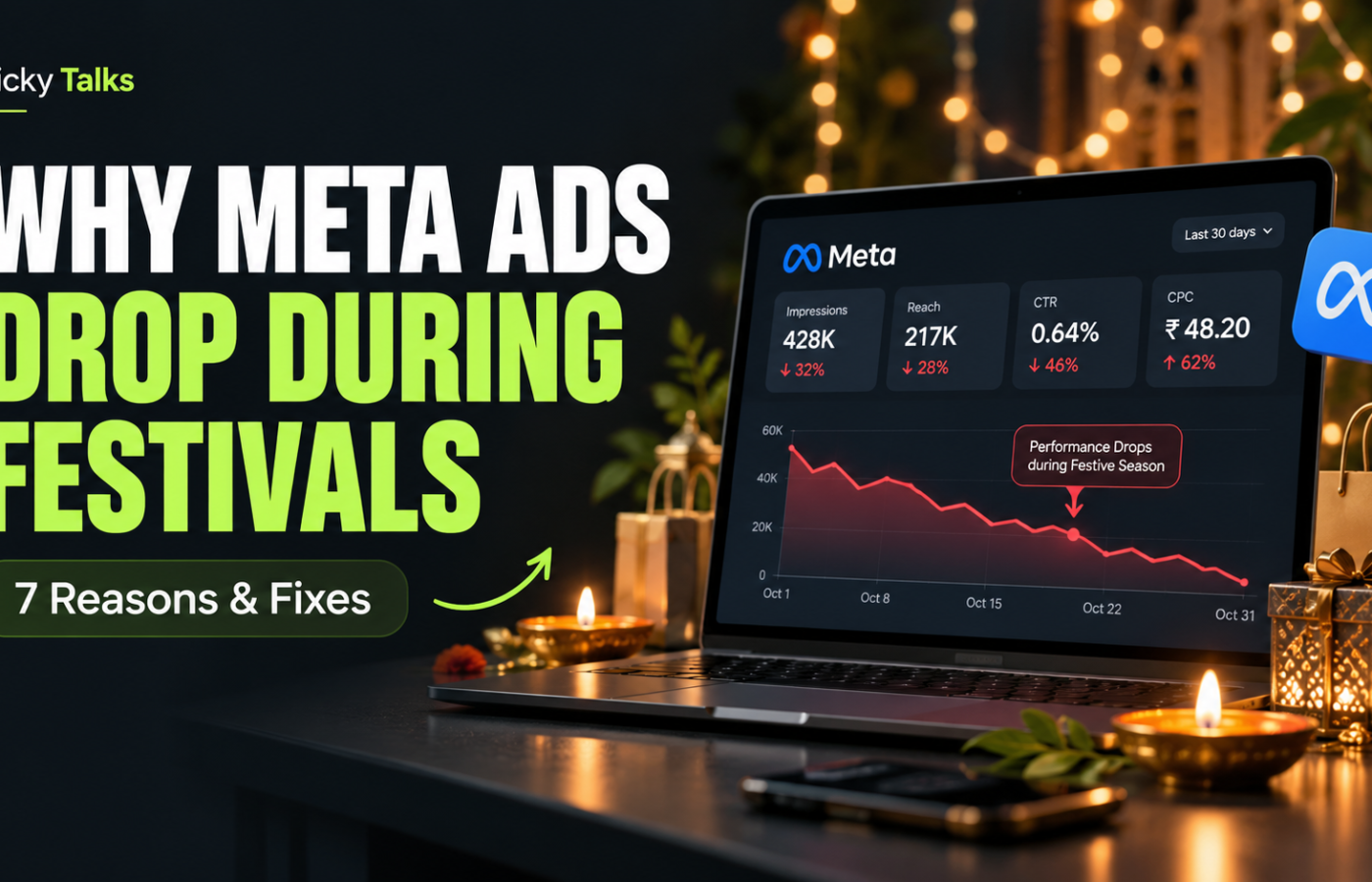
Why Meta Ads Performance Drops During Festivals: 7 Causes & Fixes

Your Meta Ads campaigns are generating leads or purchases consistently. Your cost per lead looks reasonable, your creatives are performing, and your daily budget is producing results.
Then Dussehra or Diwali arrives.
Suddenly, your cost per lead increases, purchases decline, and the same campaign that worked last week starts struggling.
You haven’t changed the creatives. Your targeting is the same. Your budget hasn’t increased.
So why are your Meta Ads suddenly performing worse?
Meta Ads performance can decline during festivals because advertiser competition increases, consumer purchasing priorities change, and conversion rates fluctuate. Higher CPM, weaker purchase intent, creative fatigue, and campaign changes can combine to increase acquisition costs. However, not every business performs worse during festivals. Some industries experience their strongest sales.
The solution isn’t automatically to pause your campaigns or blame Meta’s algorithm.
It’s to understand what changed and identify the right fix.
In this guide, we’ll break down seven common causes, explain the numbers behind them, and build a practical framework you can use to diagnose your own Facebook and Instagram ad campaigns.
Quick Answer: Why Do Meta Ads Perform Poorly During Festivals?
Here are the seven most common explanations:
- Increased competition: More advertisers competing for similar audiences can increase CPM.
- Changing customer priorities: Consumers may spend more on festive purchases and postpone other buying decisions.
- Lower conversion rates: People may still click your ads but purchase less frequently.
- Aggressive competitor offers: Seasonal promotions can make your existing offer less attractive.
- Creative fatigue: Existing advertisements may lose effectiveness as competition for attention increases.
- Unnecessary campaign changes: Repeated edits can destabilize delivery and make performance harder to diagnose.
- Tracking or technical problems: Attribution differences, checkout failures, or delivery issues can resemble a seasonal performance decline.
These factors can operate independently or simultaneously.
Let’s understand how.
1. How Does the Meta Ads Auction Work During Festivals?
Before discussing festival-specific problems, you need to understand how Meta decides which advertisements appear on Facebook and Instagram.
Unlike traditional advertising, Meta doesn’t simply show your ad because you’ve allocated a particular budget.
Meta uses an advertising auction.
Whenever there’s an opportunity to display an advertisement, multiple eligible ads may compete for that impression.
According to Meta’s published explanation, the auction evaluates three major factors:
| Auction factor | What it means |
|---|---|
| Advertiser bid | The amount an advertiser is willing to bid toward the selected advertising objective |
| Estimated action rate | Meta’s prediction of whether the user will complete the desired action |
| Ad quality | Signals about relevance, user feedback, and the advertising experience |
The combination determines an advertisement’s total value.
The advertiser willing to spend the most does not automatically win the auction.
A relevant advertisement with strong predicted performance can outperform another advertiser with a higher bid.
Source: Meta — How Ad Auctions Work.
What Changes During Diwali or Dussehra?
Imagine you’re advertising an online video editing course.
During a normal week, you’re competing with educational businesses, coaching institutes, software companies, and other advertisers interested in similar users.
During Diwali, additional businesses may aggressively advertise:
- Clothing and fashion accessories.
- Electronics and smartphones.
- Jewellery and gifting products.
- Home appliances and furniture.
- Travel, automobiles, and festive promotions.
These advertisers may overlap with the audience you’re trying to reach.
The number of competing campaigns, their bids, predicted response rates, and the available advertising opportunities can all change.
As a result, the economics of reaching your potential customers may change.
Important: Festival competition does not guarantee that CPM will increase. The effect varies by audience, placement, campaign objective, location, and advertisement quality.
How Competitive Is India’s Festive Advertising Market?
The Datum Intelligence 2026 Festive Advertising Forecast estimates that India’s festive advertising expenditure could reach ₹60,000–₹62,000 crore in 2026, representing approximately 13–17% year-over-year growth.
The report estimates that festive spending accounts for approximately 34–35% of India’s annual advertising expenditure.
These figures cover advertising across multiple channels, not Meta Ads alone.
Nevertheless, they illustrate why brands treat the festive season as an important period for customer acquisition.
More promotional activity can increase competitive pressure in certain advertising auctions.
For a deeper explanation of Meta’s AI-driven ad retrieval and delivery systems, read our guide to Meta Andromeda and how it changes advertising.
2. Reason #1: Increased Competition Can Raise CPM and Acquisition Costs
One of the first metrics you should inspect during a festival is CPM.
What Is CPM in Meta Ads?
CPM stands for Cost Per Mille, or the average cost of 1,000 ad impressions.
It’s calculated as:
CPM = (Amount Spent ÷ Impressions) × 1,000
For example, suppose you spend ₹1,000 on Meta Ads and generate 10,000 impressions.
Your CPM is ₹100.
Now imagine festive competition contributes to your CPM increasing to ₹200.
With the same ₹1,000 budget, you could receive approximately 5,000 impressions.
Your advertising budget remains unchanged, but your advertisement is shown fewer times.
Example: How a Higher CPM Affects Purchases
Let’s compare two hypothetical scenarios.
| Metric | Normal period | Festival period |
|---|---|---|
| Daily budget | ₹1,000 | ₹1,000 |
| CPM | ₹100 | ₹200 |
| Impressions | 10,000 | 5,000 |
| Link CTR | 2% | 2% |
| Link clicks | 200 | 100 |
| Website conversion rate | 2% | 2% |
| Purchases | 4 | 2 |
| Cost per purchase | ₹250 | ₹500 |
Illustrative example. The calculations assume counted link clicks correspond to website visits and all other factors remain constant.
The key observation is that the conversion rate hasn’t changed.
Your creative is generating the same CTR.
Your website is converting the same percentage of visitors.
But your cost per purchase doubled because you’re receiving fewer impressions and clicks for the same budget.
Does Higher CPM Always Mean Bad Performance?
No.
Let’s say you sell a product for ₹2,000.
If a higher CPM produces customers who purchase more frequently or spend more per order, your business could still be profitable.
This is why judging a campaign only by CPM can be misleading.
The important questions are:
- What is your final cost per acquisition?
- How much revenue does each customer generate?
- Is the campaign profitable after considering your actual margins?
How to Fix High CPM During Festivals
Start by comparing CPM with your normal baseline.
Then examine performance by placement, audience segment, geography, and creative.
If your cost per acquisition remains profitable, you may not need to make changes.
If higher CPM is contributing to unprofitable acquisition costs, investigate creative relevance, audience reach, and bidding constraints.
Don’t increase your budget simply because impressions have become expensive.
If you’re managing a smaller advertising budget, our Meta Ads ₹500-per-day planning guide explains how to structure spending without unnecessarily fragmenting campaign data.
3. Reason #2: Consumer Buying Priorities Change During Festivals
Here’s something many advertisers underestimate.
People don’t necessarily stop spending money during festivals. They change what they spend money on.
Imagine a working professional earning ₹50,000 per month.
During a normal month, they might be interested in spending ₹2,000 on an online course.
During Diwali, however, they might prioritize family travel, clothing, gifts, home improvements, or festival celebrations.
Their interest in the course may remain.
But the urgency to purchase might decrease.
That creates a problem for businesses selling products or services that aren’t directly related to the festive season.
Example: Two Businesses Advertising During Diwali
Consider two advertisers.
Business A: Fashion brand
The brand sells festive clothing.
Customers have a time-sensitive reason to purchase because they want new outfits for upcoming celebrations.
Business B: Online course creator
The business sells an online digital marketing course.
Customers may find the course valuable, but they could postpone enrolment until after the festival.
Both businesses might face competitive auctions.
However, their customers’ purchase intentions can be completely different.
Business A might experience higher demand, whereas Business B may experience delayed purchasing decisions.
This isn’t a universal rule. Some educational products may also benefit from seasonal offers or career-planning behaviour.
What Should You Do?
Think about the customer’s situation before changing targeting.
Ask yourself:
- Is my product an immediate priority during the festival?
- Does the customer have a strong reason to purchase now?
- Am I communicating the value clearly enough?
- Would a different offer or message match the customer’s current needs?
For an educational product, you could emphasize flexible learning, practical skill development, or genuine post-festival enrolment benefits.
For a service business, you might offer appointment scheduling for dates after the holiday.
The objective is to align your message with the customer’s current decision-making process.
4. Reason #3: Your Ads Get Clicks, but Fewer People Convert
This is one of the most frustrating situations for advertisers.
Your CTR looks healthy.
People are clicking your ads.
Your website receives traffic.
But purchases aren’t happening.
What’s going wrong?
CTR and Conversion Rate Measure Different Things
CTR tells you how frequently people click after seeing your advertisement.
Conversion rate tells you how frequently visitors complete a desired action.
These are related but fundamentally different metrics.
An ad can attract attention without generating purchase intent.
During festivals, people may browse products, compare offers, save links, or postpone decisions.
That can reduce your website conversion rate even when your CTR remains consistent.
Example: Conversion Rate Falls From 4% to 2%
Imagine your advertising campaign generates 200 website visits.
Normally, 4% of visitors purchase.
That gives you eight purchases.
During the festive period, imagine the conversion rate decreases to 2%.
You still receive 200 visitors.
But you generate only four purchases.
Your cost per purchase has doubled, even though your traffic hasn’t declined.
How Do You Identify This Problem?
Look at the entire conversion funnel:
| Funnel stage | Metric to inspect | What it reveals |
|---|---|---|
| Ad impression | CPM | Cost of reaching the audience |
| Ad click | Link CTR and CPC | Whether people respond to the creative |
| Website visit | Landing page views | Whether users successfully reach the page |
| Product interest | Add-to-cart rate | Whether the offer generates purchase interest |
| Checkout | Initiate checkout rate | Whether users progress toward payment |
| Sale | Website conversion rate | Whether traffic becomes customers |
For lead-generation campaigns, replace purchase events with relevant stages such as form submissions, qualified leads, appointments, and completed sales.
How to Fix Low Conversion Rates
First identify where the drop happens.
If landing page views decline relative to link clicks, check loading times and page availability.
If add-to-cart rates decline, investigate product appeal, pricing, and offer relevance.
If checkout initiations remain stable but purchases decline, investigate payment failures, hidden charges, and checkout friction.
If raw leads remain stable but qualified leads fall, examine lead quality rather than simply trying to generate more submissions.
For businesses deciding between landing pages, WhatsApp, and Instant Forms, read our guide: Do You Need a Website for Meta Ads?.
The main principle is simple:
Find the stage that’s underperforming before changing the campaign.
5. Reason #4: Your Competitors Are Offering Better Festive Deals
During festivals, customers often compare several brands before purchasing.
Imagine a customer sees three advertisements.
Brand A offers a 15% discount.
Brand B offers free shipping and a product bundle.
Brand C offers the regular product at its usual price.
Which advertisement will attract the customer’s attention?
The answer depends on more than discounts, but the perceived value of each offer certainly matters.
Your advertisement might be technically well optimized.
It could have a good creative, strong CTR, and appropriate audience targeting.
But if the offer is weak compared with relevant alternatives, conversion rates may suffer.
Example: An Online Course
Suppose your course costs ₹1,999.
A competitor offers a similar course at ₹1,499 during a promotional period.
A customer comparing both courses might hesitate before choosing yours.
Does that mean you should immediately discount your course?
Not necessarily.
You might have advantages such as:
- Better practical demonstrations.
- More comprehensive lessons.
- Genuine student success stories.
- More relevant projects.
- Recorded sessions or learning resources.
- Access to support that competitors don’t offer.
Communicating those benefits may be more sustainable than continuously reducing prices.
How to Improve Your Offer During Festivals
Audit your offer from the customer’s perspective.
Why should someone choose your product?
What value are you delivering?
Is that value obvious within the first few seconds of the advertisement and on the landing page?
A strong offer should make the purchasing decision easier without relying on misleading discounts or artificial urgency.
6. Reason #5: Creative Fatigue and Attention Competition
Let’s say you’ve been running the same advertisement for several weeks.
It initially generates strong results.
Over time, the performance starts declining.
Your CTR decreases.
Your CPC increases.
Your conversion costs become less predictable.
One possible explanation is creative fatigue.
What Is Creative Fatigue?
Creative fatigue occurs when repeated exposure reduces an advertisement’s ability to generate a response from the people seeing it.
This can be especially relevant when you’re repeatedly reaching a relatively small audience.
During festive periods, users may also encounter attractive seasonal promotions from other businesses.
Even if your advertisement hasn’t changed, the environment in which people encounter it has changed.
How to Diagnose Creative Fatigue
Look at multiple metrics together.
Increasing frequency, falling CTR, rising CPC, and deteriorating results can indicate fatigue.
However, don’t treat frequency as proof on its own.
For example, remarketing campaigns often intentionally show ads multiple times to interested users.
You need to interpret frequency alongside audience size, campaign objective, creative engagement, and business outcomes.
How to Fix Creative Fatigue
Test meaningfully different creative concepts.
For a digital marketing course, you could experiment with:
- A beginner’s problem and solution.
- A practical screen-recording tutorial.
- A demonstration of a specific skill.
- A genuine student testimonial.
- A comparison between two learning approaches.
- A creator-led explanation of common mistakes.
Don’t simply replace the headline while keeping the same idea.
Try different messages, objections, demonstrations, and value propositions.
Meta’s automated systems increasingly use creative signals when determining ad delivery, which makes genuinely relevant creative variation important.
You can learn more about that process in our Meta Andromeda guide.
7. Reason #6: Too Many Campaign Changes Can Make Performance Worse
Imagine this situation.
Your campaign usually generates 10 leads per day.
During a festival, results fall to five leads.
You become concerned.
So you increase the budget, change targeting, replace creatives, and duplicate the campaign.
The next day, performance is still inconsistent.
You make even more changes.
Now you’ve introduced several new variables without understanding the original problem.
What Happens During Meta’s Learning Phase?
Meta uses delivery data to improve predictions about which users are more likely to complete the selected optimization event.
When you launch a new ad set or make certain significant edits, the affected ad set may enter or re-enter the learning phase.
Results can be less stable while the system gathers information.
But learning status isn’t the only reason performance changes, and exiting the learning phase doesn’t guarantee profitability.
Why Frequent Changes Create Problems
If you modify your budget, creative, audience, and conversion setup at the same time, it’s difficult to determine which change affected performance.
This is particularly problematic during festivals, when consumer behaviour and auction conditions may already be changing.
What Should You Do Instead?
Use a controlled optimization process.
First, identify the metric that deteriorated.
Next, develop a specific explanation.
Then test the most relevant change.
For example:
If CPM increased but CTR and conversion rate remained stable, investigate acquisition economics and auction conditions first.
If CPM remained stable but CTR declined, creative relevance deserves closer examination.
If CTR remained stable but purchase conversion rates declined, start by inspecting the website and offer.
Avoid making multiple major edits simply because one or two days were disappointing.
For a deeper explanation of budget planning and gradual adjustments, see our guide to running Meta Ads with ₹500 per day.
8. Reason #7: Sometimes the Problem Is Technical, Not Seasonal
It’s tempting to blame every October performance decline on Dussehra or Diwali.
But that can lead to the wrong diagnosis.
Occasionally, campaigns perform poorly because of technical problems unrelated to festivals.
These can include:
- Ad delivery interruptions.
- Account or payment restrictions.
- Incorrect campaign configuration.
- Landing-page errors.
- Checkout failures.
- Broken Meta Pixel events.
- Conversions API implementation problems.
- Attribution and reporting differences.
Example: Your Store Shows More Purchases Than Meta
Suppose your online store reports 20 purchases.
Ads Manager reports 12 purchases.
That doesn’t automatically mean eight purchases disappeared.
The two systems measure different things.
Your store tracks its transactions, while Ads Manager attributes eligible conversions to advertising interactions under particular measurement settings.
Differences can arise from attribution windows, reporting delays, privacy restrictions, missing events, or sales generated through other channels.
How to Check for Tracking Problems
Compare Meta Ads Manager with your store or CRM.
Review your Pixel and Conversions API events.
Test your checkout and lead-submission process.
Check whether unusual delivery changes coincide with account warnings or technical incidents.
Don’t assume every tracking discrepancy represents lost sales.
And don’t assume every sales decline represents an algorithm malfunction.
The purpose of troubleshooting is to separate a market problem from a technical problem.
9. Why Do Some Businesses Perform Better During Festivals?
If competition increases during festive periods, why do some advertisers generate record sales?
Because increased competition and increased consumer demand can happen at the same time.
Some categories benefit directly from festive shopping.
Others may experience delayed purchase decisions.
Consider these examples:
| Business type | Potential festive behaviour | What advertisers should prioritize |
|---|---|---|
| Fashion and jewellery | Stronger festive purchase demand | Conversion rate, margins, stock and ROAS |
| Electronics | Increased deal comparison | Product differentiation, pricing and fulfilment |
| Online education | Some customers postpone enrolment | Learning outcomes, leads and follow-up |
| Real estate | Enquiries and purchase decisions may occur on different schedules | Qualified CPL, site visits and bookings |
| Local services | Non-urgent appointments may be delayed | Advance bookings and sales response |
| High-ticket investments | Longer research and consideration cycles | Lead quality, trust and conversion progression |
These are possible patterns, not guarantees.
For example, Dussehra can be considered an auspicious period for certain purchases, which may increase buying activity in relevant categories.
The important question isn’t whether festivals are good or bad for advertising overall.
It’s whether the festival changes demand for your specific product, audience, and offer.
10. How to Diagnose Meta Ads Performance Drops: A Practical Framework
Now we come to the most important part.
Instead of guessing why your ads stopped performing, let’s use data to identify the actual problem.
Step 1: Compare the Correct Dates
Choose a reasonable baseline period before the festival.
Compare it with the relevant festival period.
For Dussehra 2026, for example, you could examine September performance against October’s Navratri–Dussehra period.
However, daily and weekly patterns can affect results.
Try to compare equivalent weekday mixes, campaign settings, and attribution definitions.
If you have enough history, compare the corresponding festival period in previous years as well.
Step 2: Check the Right Metrics
Open Meta Ads Manager and customize your reporting columns.
Include:
- Amount spent.
- CPM.
- Impressions.
- Frequency.
- Link CTR.
- CPC (link).
- Landing page views.
- Leads or purchases.
- Cost per result.
- Purchase conversion value.
- ROAS, where applicable.
Also review the actual sales or qualified leads recorded in your business systems.
Step 3: Identify the Problem Pattern
| Performance pattern | Possible explanation | Recommended first investigation |
|---|---|---|
| CPM increases, CTR remains stable | More expensive impression inventory | Auction costs, placements and acquisition economics |
| CTR decreases, CPM remains stable | Creative or audience relevance | Creative hooks, fatigue and targeting |
| CPC increases | Higher CPM, lower CTR, or both | CPM and CTR separately |
| Clicks remain stable, purchases decline | Lower conversion rate | Offer, website and checkout |
| Leads remain stable, lead quality declines | Lower-quality enquiries | CRM outcomes and qualification |
| Meta purchases decline, store purchases remain stable | Attribution or tracking differences | Pixel, CAPI and attribution settings |
| Ad spend suddenly stops | Delivery or account issue | Payment, restrictions and delivery status |
One metric alone rarely tells the whole story.
Look for relationships between metrics.
For example, higher CPC could result from an increase in CPM, a decrease in CTR, or both.
That distinction determines what you should investigate.
Step 4: Choose the Appropriate Response
When CPM is the main problem, evaluate auction costs and overall profitability.
When CTR is the main problem, review creative performance.
When purchase conversion rates fall, inspect the website and offer.
When qualified lead rates decrease, evaluate targeting signals, lead forms, and follow-up processes.
And when Ads Manager results differ significantly from backend business data, investigate attribution and tracking.
The objective is to fix the underlying cause, not whichever metric looks most alarming.
A Practical Resource: Meta Ads Optimization Checklist
Diagnosing Meta Ads can become confusing when CPM, CTR, CPC, conversion rates, ROAS, and creative performance change together.
That’s why we’ve created the Vicky Talks Meta Ads Optimization Checklist.
It includes more than 205 actionable checkpoints across 11 important performance areas, including CPM, CTR, CPC, ROAS, creative performance, and scaling.
The checklist helps you systematically review high, low, and plateau performance scenarios and identify what to investigate next.
Instead of randomly editing campaigns, use it as a structured troubleshooting reference.
Explore the Meta Ads Optimization Checklist
11. Real-World Math: How Festival Competition Can Triple Your CPA
Let’s work through a simplified advertising example.
Imagine you’re spending ₹1,000 per day.
Your campaign generates purchases on your website.
During a normal period, your metrics are:
| Metric | Value |
|---|---|
| Daily budget | ₹1,000 |
| CPM | ₹100 |
| Link CTR | 2% |
| Website conversion rate | 2% |
| Expected purchases | 4 |
| Expected CPA | ₹250 |
Now imagine festival competition contributes to CPM increasing from ₹100 to ₹150.
Your CTR and website conversion rate remain unchanged.
Your expected cost per purchase increases from ₹250 to ₹375.
That’s a 50% increase.
But what happens if customer purchase intent also changes?
Suppose your website conversion rate decreases from 2% to 1%.
Your expected cost per purchase becomes ₹750.
Compare all three scenarios.
| Scenario | CPM | Conversion rate | Expected CPA |
|---|---|---|---|
| Normal period | ₹100 | 2% | ₹250 |
| Festival: Higher CPM | ₹150 | 2% | ₹375 |
| Festival: Higher CPM + Lower CVR | ₹150 | 1% | ₹750 |
The final cost per purchase is three times the original amount.
Your CPA increased by 200%, despite your daily advertising budget staying exactly the same.
These calculations assume a constant 2% link CTR, that counted link clicks become counted website visits, and that other factors remain unchanged. Fractional expected conversions are averages, not literal daily purchase counts.
What Does This Example Teach Us?
Small changes across multiple stages of your advertising funnel can combine into large changes in acquisition cost.
That’s why reducing CPM alone may not solve your problem.
You need to understand the relationship between:
CPM → CTR → CPC → Conversion Rate → CPA → ROAS
If you want a broader framework for evaluating whether campaigns make financial sense, read our article on whether Meta Ads are worth running for your business.
12. What Should You Do Before, During, and After Festivals?
Let’s turn this into a repeatable advertising strategy.
Before the Festival: Prepare Your Campaigns
Review past performance, if available.
Determine whether your product historically benefits from festive buying behaviour.
Identify profitable campaigns, inspect your tracking setup, and ensure your website and checkout work properly.
Test new creative concepts ahead of time where practical.
If you’re planning a promotion, calculate whether the offer remains profitable after discounts, advertising expenses, fulfilment costs, and returns.
For lead-generation businesses, make sure your team can follow up with enquiries during the festive period.
During the Festival: Monitor the Right Numbers
Track campaign performance using a consistent reporting process.
Focus on business outcomes rather than reacting to every daily fluctuation.
Compare CPM, CTR, conversion rates, CPA, and qualified lead quality.
If the campaign remains profitable, higher CPM alone may not justify pausing it.
If acquisition costs become unsustainable, investigate what changed before making major adjustments.
Avoid increasing budgets simply to compensate for disappointing results.
After the Festival: Evaluate and Recover
Review performance across the complete festival window.
Compare your advertising metrics with actual business outcomes.
Identify which campaigns remained profitable and which audiences or offers struggled.
Follow up with customers who expressed genuine interest but postponed their purchases.
You can also test revised offers and fresh creatives based on the information collected during the festive period.
Don’t expect results to return to historical averages immediately after a festival.
Measure the actual trend.
13. Should You Pause Meta Ads During Diwali or Dussehra?
You should not automatically pause Meta Ads during a festival. The decision should depend on profitability, lead quality, operational capacity, and the reasons behind your performance changes.
Here’s a practical decision framework.
Continue Advertising If:
Your campaigns remain within acceptable acquisition-cost limits.
Your leads or purchases are commercially valuable.
Your business can fulfil orders or follow up with enquiries.
And your data doesn’t indicate a serious technical problem.
Reduce Your Budget If:
Acquisition costs are consistently above your sustainable limits.
Lead quality has declined.
Conversion rates are falling without sufficient compensating value.
Or your business has limited staff availability during the holiday.
Consider Pausing If:
Your website or payment process is broken.
You cannot serve incoming customers.
Your tracking or delivery configuration has a serious issue.
Or available evidence suggests continued spending is commercially unjustified.
There is no universal rule that every campaign should be paused for two days, seven days, or the entire festival.
Your business economics should drive that decision.
14. Frequently Asked Questions
Why does Meta Ads CPM increase during Diwali?
CPM can increase when additional advertisers compete for similar audiences and advertising placements. However, CPM is also influenced by ad quality, predicted user response, placement, geography, and other auction conditions. Not every campaign experiences a festival-related CPM increase.
Why are my Facebook Ads getting clicks but no sales?
Your advertisement may be attracting interest without sufficient purchase intent. Check landing-page performance, the offer, product pricing, conversion rate, checkout experience, and attribution before changing targeting.
Does Meta deliberately increase advertising costs during festivals?
Meta’s published auction model does not establish a universal festival surcharge. Advertising costs can change as bids, competition, predicted action rates, and ad quality change.
Is it better to stop Meta Ads during Dussehra?
Not necessarily. Campaigns should be evaluated against their actual profitability and business objectives. Continue profitable campaigns and investigate underperforming ones rather than applying the same decision to every account.
How can I reduce cost per lead during festivals?
Identify whether the increase comes from higher CPM, lower CTR, or a weaker conversion rate. Then improve the relevant stage through creative testing, offer refinement, audience analysis, or funnel optimization. Also measure qualified leads, not merely form submissions.
Why is my Meta Ads ROAS lower during Diwali?
Possible causes include increased acquisition costs, reduced purchase conversion rates, lower average order value, changes in product mix, or attribution differences. Compare both ad-platform reporting and actual sales data.
How long will Meta Ads take to recover after a festival?
There is no fixed recovery period. Performance depends on ongoing auction competition, customer demand, campaign configuration, and the business’s offer. Monitor trends rather than expecting a guaranteed recovery date.
Can I run Meta Ads on a small budget during festivals?
Yes, but small budgets may produce limited data, and increased auction costs can make performance harder to evaluate. Keep campaign structures manageable, prioritize a clearly defined objective, and judge results against realistic economics.
15. Final Thoughts: Don’t Blame the Algorithm Without Checking Your Data
When Meta Ads performance drops during Dussehra, Diwali, or any major festive season, the easiest explanation is often:
“Meta’s algorithm isn’t working.”
But that explanation can prevent you from finding the actual problem.
Sometimes the cost of reaching customers increases.
Sometimes consumers shift their purchasing priorities.
Sometimes your offer becomes less competitive.
Sometimes existing creatives lose effectiveness.
And sometimes the problem is technical.
The important skill isn’t predicting every change in advertising performance.
It’s learning how to diagnose changes systematically and make better marketing decisions using data.
That’s the approach we encourage at Vicky Talks.
Instead of blindly following marketing trends, understand how advertising systems work, how consumers make decisions, and how to interpret the numbers behind your campaigns.
When you understand those fundamentals, you’re better equipped to manage unpredictable periods—not just during festivals, but throughout the year.
Learn Marketing, Data & AI With Vicky Talks
At Vicky Talks, we simplify digital marketing, data, artificial intelligence, and practical business growth for business owners, freelancers, marketers, and creators.
Explore our marketing tutorials and guides to build stronger campaigns and make more informed business decisions.
And if you’re currently struggling with campaign performance, use our Meta Ads Optimization Checklist to systematically investigate your advertising metrics.
Stop guessing. Start understanding your marketing data.
Sources & Further Reading
The explanations in this article draw on platform documentation, market research, and practical campaign-analysis principles.
- Meta — How Ad Auctions Work — Advertising auctions, estimated action rates, and ad quality.
- Meta — Toward Fairness in Personalized Ads — Technical discussion of auction value and personalized ad delivery.
- Datum Intelligence — 2026 Festive Advertising Forecast — Indian festive advertising expenditure estimates.
- Datum Intelligence — Festive Barometer 2026 — Festive online shopping forecasts and demand trends.
- Jon Loomer — How the Facebook Ad Auction Works — Independent explanation of auction mechanics.