How To Do Marketing For Real Estate: Why Cheap Leads Don’t Become Site Visits (and the System That Fixes It)

Real estate owners across India are spending lakhs on Meta ads. The leads come in. The phone keeps ringing. Ads Manager says each lead is cheap. Someone screenshots it and sends it to the partners.
Then the month ends. The sales team opens the sheet. Hundreds of leads. A handful of site visits. Even fewer bookings. And the conclusion is always the same: “Meta ads don’t work in our area.”
We see this pattern again and again across farmland, villa and apartment projects. In most of these cases, the ads did their job. What failed is everything that should have happened after the lead.
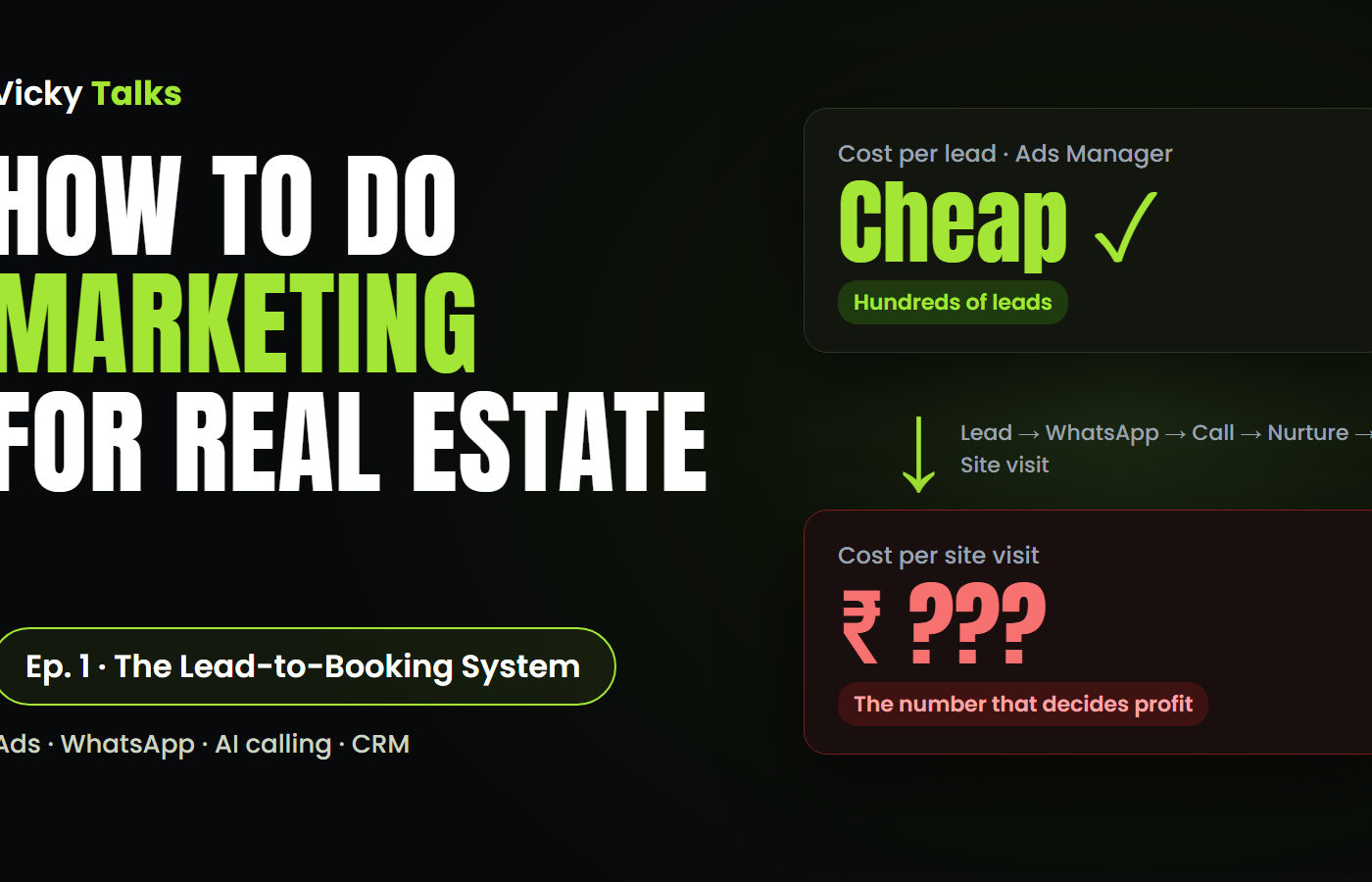
Quick answer: to do marketing for real estate well, stop judging ads by cost per lead. Cost per lead only measures form fills. What decides profit is the cost per site visit and the cost per booking, and those depend on the system behind your ads: how fast you respond, how you qualify, how you nurture for weeks, and whether you tell Meta which leads turned into visits.
This is episode 1 of our How To Do Marketing For… series, where we take one business at a time: the problem everyone in that market faces, where it breaks, and the complete system to fix it. In this post: the one number to judge real estate ads by, the Site Visit Number, and the full lead-to-booking system (CRM, WhatsApp, calling, nurturing and site visits).
The real estate marketing problem: cheap leads, empty sites
Here’s how it usually goes. A project starts lead-generation ads with Meta instant forms. The cost per lead looks low on day one. A tele-caller gets the list the next day. Half the numbers don’t pick up. Some say “I never filled any form.” A few say “just checking the price.” Follow-ups slip. By week three the sales team says the leads are useless, the budget gets increased to “get better leads”, and by week four the ads are switched off.
What is a good cost per lead for real estate?
Indian agency blogs that publish real estate benchmarks quote anything from about ₹80 to ₹2,000 per Meta lead depending on city, segment and form type (see for example this industry table and this pricing guide). Be careful with these: they don’t publish how they calculated them, and they disagree with each other a lot. Treat them as a rough range, not a target.
The better question isn’t “is my cost per lead good?” It’s “what does one site visit cost me, and what does one booking cost me?” A cheap lead is the price of a form fill, not the price of a buyer.
Why cheap leads don’t automatically become site visits
A lead in Ads Manager is simply someone who submitted your instant form. Meta’s default form type is literally called More volume, and Meta describes it as a form that’s quick to fill out and submit on a mobile device and designed to generate a larger number of leads (About instant form types, Meta Business Help Center).
Quick to submit is good for volume. It also means some people tap through prefilled details without strong intent: they wanted the price, were curious, or don’t remember filling it in when your sales team calls.
That’s why the same ad spend can look like a success at the lead stage and a failure at the booking stage. The ads did their job. The gap is between the form and the site.
The Site Visit Number (the only number to judge real estate ads by)
Here’s the formula:
Site Visit Number = Total ad spend ÷ Number of people who actually visited the site
And one step further:
Cost per booking = Total ad spend ÷ Number of bookings
A simple example (example numbers, not a real project): say you spend ₹50,000 and get 500 leads. That’s ₹100 a lead.
| If site visits were… | Site Visit Number |
|---|---|
| 10 | ₹5,000 per visit |
| 25 | ₹2,000 per visit |
| 50 | ₹1,000 per visit |
Same ads, same ₹100 leads, five times the difference per visit. That difference is decided by what happens after the form, not by Meta.
Now compare your Site Visit Number with your margin per plot or flat and your typical visit-to-booking ratio. If the cost of the visits it takes to get one booking fits comfortably inside your margin, your ads are working, whether your cost per lead is ₹80 or ₹300.
What decides how many leads become visits
1. How fast you call
Speed to lead is the most repeated finding in lead-generation research. A widely cited 2007 study by InsideSales.com with MIT researcher Dr. James Oldroyd reported that calling a web lead within 5 minutes, instead of 30, made it dramatically more likely that the lead was reached and qualified. In 2011, Harvard Business Review published “The Short Life of Online Sales Leads” by Oldroyd, McElheran and Elkington, which states that most companies are not responding nearly fast enough.
Honesty note: the original 2007 report isn’t publicly available and the HBR article is paywalled, so we’re not quoting the exact multipliers you’ll see repeated online. The direction is consistent across sources: minutes matter, hours hurt.
In practice for real estate: a lead that gets a call within 5 minutes still remembers your ad. A lead that gets a call two days later has often already spoken to two other projects.
2. Which form type you use
Meta offers three instant form types (Meta Business Help Center):
- More volume (default): quick to submit, designed for more leads.
- Higher intent: adds inline text under the contact fields saying your business may follow up, plus an extra review screen where people confirm their details. Meta says this helps prevent submissions from people who are only marginally interested, and that it may make more sense if follow-up or qualification is needed on every lead. Note: it only delivers on Facebook and Instagram feeds on mobile.
- Rich creative: more branding, images and context in the form.
Meta also lets you require SMS verification (one-time password) before the form submits, as long as phone number is a required field (How to create an instant form in Meta Ads Manager). For real estate, where wrong numbers waste your sales team’s day, that’s worth testing.
Expect fewer leads with these filters. You’re trading volume for leads that pick up the phone.
3. One qualifying question
Instant forms allow up to 15 custom questions, including multiple choice and appointment requests (Meta Business Help Center). You don’t need 15. One honest question like “When are you planning to buy?” or “What budget are you considering?” tells your sales team who to call first.
4. Whether you record what happened to every lead
If you don’t know which leads were called, which visited and which booked, you can’t calculate your Site Visit Number, and neither can Meta. A simple sheet with four statuses is enough to start: New → Contacted → Site visit → Booked.
Telling Meta which leads were good: Conversion leads (qualified leads) optimisation
By default, Meta optimises for people likely to submit a form. Meta also offers a performance goal called Maximize number of qualified leads (often called conversion leads), which shows your ads to people more likely to convert after sharing their details (About performance goals for lead ads).
For that to work, you send your CRM’s lead stages (for example “site visit”) back to Meta using the Conversions API for CRM. What Meta reports:
- Instant form lead ads using Conversions API for CRM with the qualified leads goal saw 21% lower cost per quality lead than ads optimised for leads, in a budget-controlled A/B test with 567 advertisers, 13 to 27 January 2025 (Meta).
- For website forms, Meta reports 9.5% lower cost per quality lead in a test with 69 advertisers, August to September 2025 (same source).
- In an October 2025 announcement Meta separately reported an average 19% lower cost per quality lead for advertisers using Conversions API for CRM with the conversion leads goal (Meta for Business).
These are Meta’s own results, averages across advertisers, and Meta itself says performance isn’t guaranteed. They’re still the best official data available.
Important 2026 change: Meta states that beginning April 2026 the qualified leads performance goal is no longer available for new campaigns without a Conversions API integration, and existing campaigns are affected from August 2026 (Meta).
Is your business a good fit? The honest check
Meta’s developer guide lists who this optimisation suits (Conversions API for CRM integration):
- You use Facebook/Instagram lead ads (instant forms)
- You generate at least 200 leads per month
- You can upload data at least once per day
- The stage you optimise for (e.g. site visit) happens within 28 days of the lead
- That stage has a conversion rate between 1% and 40%
Many individual real estate projects generate fewer than 200 leads a month. If that’s you, you’re below Meta’s guideline. Your right first moves are fast calling, a higher-intent form, one qualifying question and clean lead status tracking. CRM optimisation comes once volume crosses the threshold. Most blogs won’t tell you this part.
The bigger fix: ads are only step 1 of a lead-to-booking system
Here’s what we tell every real estate owner who asks us to “fix the ads”: the ad’s job ends when the form is submitted. Everything that turns a cheap lead into a site visit happens after that, and in most projects nobody owns it. Leads sit in a CSV. A tele-caller rings them the next day. Nobody sends the brochure. Nobody follows up after the first “I’ll think about it”.
A real estate purchase is a big, slow decision. A buyer compares projects, checks approvals, asks family, and visits on a weekend. So the system has to keep the conversation alive for weeks, not minutes. This is the architecture:
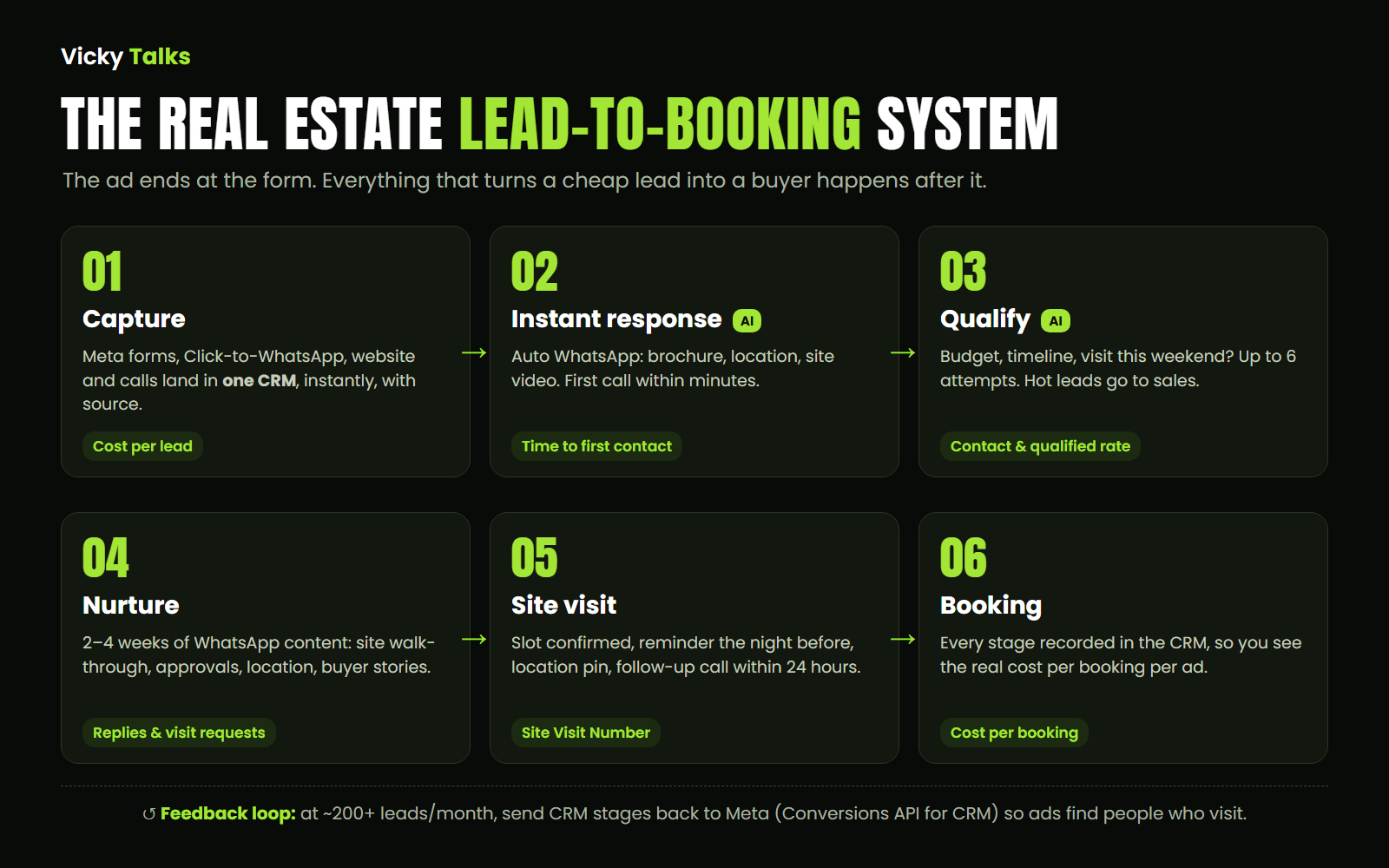
Stage 1: Capture: every lead lands in one place, instantly
Leads come from Meta instant forms, Click-to-WhatsApp ads, your website and walk-in calls. All of them must land automatically in one CRM, with the source attached, the second they arrive. Meta supports this: you can connect a CRM to lead ads, receive leads in real time via webhooks, and Meta asks you to keep its 15–17 digit lead ID so results can later be matched back (Meta lead ads developer guide, Conversions API for CRM). If you have no CRM yet, Meta’s free Leads Center in Business Suite is a starting point. A downloaded CSV once a week is not.
Stage 2: Instant response: within minutes, on WhatsApp and phone
The moment a lead arrives, two things fire automatically: a WhatsApp message with the project brochure, location pin and a short site video, and a call. As covered above, the research on speed to lead consistently says the first minutes matter most.
WhatsApp has hard numbers you can plan around, straight from Meta’s pricing documentation (Pricing on the WhatsApp Business Platform):
- Since 1 July 2025, Meta charges per delivered message, by category (marketing, utility, authentication, service). Messages from the customer to you are free.
- When a customer messages you, a 24-hour customer service window opens, in which you can reply with normal (non-template) messages.
- If the chat started from a Click-to-WhatsApp ad and you reply inside that window, a free entry point window of up to 7 days opens, during which Meta does not charge for marketing, utility, authentication or service messages.
- From 1 October 2026, every business number gets 1,000 free service messages a month. Beyond that, service messages are charged.
Per-message rates for India are published on Meta’s rate card and change from time to time, so check the current card before budgeting. In practice, that 7-day free window is one reason Click-to-WhatsApp ads are worth testing next to instant forms for real estate: a week of free conversation with someone who chose to message you.
Stage 3: Qualify: a call that asks the right three questions
Someone, or something, has to call every lead and ask: budget, timeline, and whether they want to visit this weekend. Two things matter here:
- Don’t stop after one try. Velocify’s widely cited “Ultimate Contact Strategy” study of roughly 3.5 million leads reported that about 93% of converted leads were reached by the sixth call attempt (summary, National Law Review). Note: that data is from 2012 US sales teams and comes from a software vendor, so treat it as directional, not an Indian real estate benchmark.
- Write the outcome into the CRM. Hot / warm / not interested / wrong number. Without this, Stages 4 to 6 can’t work.
Where AI fits: an AI voice agent can make that first call within a minute, at 11 pm or on a Sunday, ask the three questions in Telugu, Hindi or English, and hand hot leads to a human salesperson. It doesn’t replace your closer. It makes sure no lead waits until tomorrow. This is our view from building these systems, not a published statistic. Test it on your own leads against human calling.
Rules you must follow in India: TRAI’s February 2025 amendment to its commercial communication regulations keeps promotional calls on the 140 number series, puts transactional and service calls on the new 1600 series, and bars commercial calling from ordinary 10-digit numbers, with stricter penalties for businesses that break the rules (TRAI press release 11/2025, JSA analysis). India’s Digital Personal Data Protection Rules were notified in November 2025, with obligations phased in over 18 months (AZB & Partners). In plain words: only contact people who asked to hear from you, tell them who you are, and set up calling through a provider that follows these rules. This is a summary, not legal advice.
Stage 4: Nurture: content that answers the doubts before the visit
Most leads aren’t ready to visit on day one. The ones who aren’t go into a nurturing track: a sequence of WhatsApp messages over 2 to 4 weeks that answers the questions every buyer asks:
- Day 0: brochure, location pin, price range
- Day 2: a 60-second walk-through video of the site
- Day 5: approvals and documents explained (what’s approved, what’s proposed)
- Day 8: the area’s connectivity: roads, schools, workplaces
- Day 12: a real buyer’s story (with their permission)
- Every Thursday: “Site visits this Saturday and Sunday. Want a slot?”
Buyers already do this research themselves: a Google and Zinnov study of 6,196 people in 15 Indian cities found that more than half of real estate buying decisions were influenced by internet research (Business Standard, 2014). That study is over a decade old; online research has almost certainly grown since, but we haven’t found a recent study with published methodology, so we’re not quoting a newer number. Your nurture content means the research they do is your project, not a competitor’s.
Your YouTube videos and Instagram reels belong in this sequence too. Content you’ve already made becomes your nurturing material.
Stage 5: Site visit: book it, remind it, follow it up
Once a lead says yes: confirm the slot on WhatsApp, send a reminder the evening before and a location pin 2 hours before, and note who came. Within 24 hours of the visit, a call: “What did you and your family think?” The visit is where most bookings are decided, so the follow-up after it matters as much as the call before it.
Stage 6: Booking, and the loop back to Meta
Every stage (contacted, qualified, visited, booked) is recorded in the CRM. That gives you two things. First, your real numbers: cost per site visit and cost per booking, by ad and by source. Second, once you cross roughly 200 leads a month, you can send those stages back to Meta through the Conversions API for CRM so Meta finds more people like the ones who visited, not just people who fill forms (see the section above).
The numbers to track at each stage
| Stage | Number to track | How to calculate |
|---|---|---|
| Capture | Cost per lead | Ad spend ÷ leads |
| Response | Time to first contact | Minutes from form to first call or WhatsApp |
| Qualify | Contact rate | Leads reached ÷ total leads |
| Qualify | Qualified rate | Hot + warm ÷ leads reached |
| Site visit | Visit rate & Site Visit Number | Visits ÷ leads; ad spend ÷ visits |
| Booking | Cost per booking | Ad spend ÷ bookings |
We’re deliberately not printing “industry average” conversion rates for these stages. We couldn’t find reliable published benchmarks for Indian real estate, and the honest answer is that they vary enormously by city, ticket size and project. Your own numbers, tracked for 60 days, are the only benchmark that matters.
Is this backed by data? What’s proven vs what’s our judgment
| Claim | Evidence | Strength |
|---|---|---|
| Telling Meta which leads converted lowers cost per quality lead | Meta A/B test, 567 advertisers (21%) | Strong (Meta’s own test) |
| WhatsApp costs and free windows | Meta pricing documentation | Official |
| Calling fast increases contact and qualification | InsideSales/MIT 2007, HBR 2011 | Directional (old, vendor-linked, paywalled) |
| Multiple call attempts reach more converters | Velocify 2012, ~3.5M leads | Directional (old, US, vendor) |
| Indian buyers research online before deciding | Google/Zinnov 2014, 6,196 people | Directional (old) |
| AI calling + WhatsApp nurturing improves visits for your project | Our experience building these systems | Judgment: test it on your own leads |
Want this system built for your project?
This is exactly what we set up for real estate businesses. We don’t need to take over your ads: you can keep your current ads team or agency. We build the system that sits behind the ads and hand it over to you, end to end:
- A fast project website or landing page connected to your ads
- A CRM with your stages (new, contacted, qualified, visited, booked)
- Meta lead ads and Click-to-WhatsApp connected to the CRM in real time
- Official WhatsApp Business Platform setup with brochure, nurture and site-visit reminder flows
- AI calling for the first call and follow-ups, handing hot leads to your sales team
- The Conversions API link back to Meta once your volume qualifies
- A simple dashboard showing your Site Visit Number and cost per booking
Send a DM with the word SYSTEM to @vicky_talks_telugu on Instagram and tell us about your project.
A 7-day action plan for real estate advertisers
- Day 1: Export last month’s leads and mark each one: contacted, site visit, booked.
- Day 1: Calculate your Site Visit Number and cost per booking.
- Day 2: Set a rule: every lead gets a call within 5 minutes during working hours.
- Day 3: Duplicate your best ad set with a Higher intent form and one qualifying question. Keep the old one running for comparison.
- Day 3: Turn on SMS verification on the new form if wrong numbers are a problem.
- Day 4: Set up an instant WhatsApp reply with brochure, location and site video for every new lead.
- Day 5: Write a 2-week nurture sequence from content you already have.
- Day 4–7: Compare both ad sets on site visits, not on cost per lead.
- Once you cross ~200 leads a month: connect your CRM to Meta and test the qualified leads goal.
FAQ
What is a good cost per lead for real estate Facebook ads in India?
Published agency ranges run from under ₹100 to over ₹2,000 depending on city, segment and form type, and they rarely share methodology. A “good” cost per lead is one where your resulting cost per site visit and per booking fits your margin.
Why are my real estate leads not picking up calls?
Common reasons are slow follow-up, low-intent form settings (the default form is built for volume) and no verification of phone numbers. Faster calls, a Higher intent form and SMS verification address all three.
Should I use Higher intent forms for real estate?
Meta suggests Higher intent forms when follow-up or qualification is required on each lead, which describes real estate. Expect fewer, more intentional leads. Test it against your current form on site visits.
What is conversion leads optimisation in Meta ads?
It’s a performance goal that optimises for people likely to reach a later stage you define (like a site visit), using data you send from your CRM through the Conversions API. Meta reports 21% lower cost per quality lead for instant forms in its A/B test, and recommends it for businesses with at least 200 leads a month.
What is a lead-to-booking system in real estate?
It’s everything that happens after the ad: leads landing in a CRM instantly, an automatic WhatsApp reply and call within minutes, qualification, a WhatsApp nurturing sequence, site-visit booking and reminders, and stage tracking that can be sent back to Meta to improve targeting.
Can AI calling be used for real estate leads in India?
Yes, as a first-call and follow-up layer that hands hot leads to a human, but it must follow TRAI’s commercial communication rules (140 series for promotional calls, 1600 series for transactional and service calls) and only contact people who opted in.
How do I calculate cost per site visit?
Divide total ad spend by the number of people who actually visited your site in the same period. For example, ₹50,000 ÷ 25 visits = ₹2,000 per visit.
The bottom line
A cheap cost per lead is a nice screenshot. It isn’t a business result. Judge your real estate ads by the Site Visit Number. Build the system behind the ads (capture, instant response, qualification, nurturing, site visits, booking) before you blame the ads, and only then let Meta learn from your best leads.
Related reads: Boosting a post vs running a real ad campaign · Meta ads on ₹500 a day · Is it worth running Meta ads for a business?
Disclosure: all spend, lead and visit figures in this post are example numbers to explain the formula, not data from any specific project. Meta test results are Meta’s own published figures and are not a guarantee of performance. Regulatory points are summaries, not legal advice. WhatsApp pricing details are as published by Meta in November 2026 and may change.